
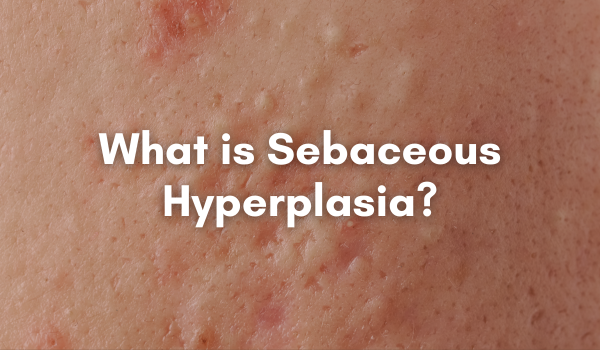
If you’ve noticed small but persistent flesh-colored or yellowish bumps on your skin or face, especially around the forehead, cheeks, or nose, you may be wondering what they are and how to get rid of them. One common possibility is sebaceous hyperplasia.
What is sebaceous hyperplasia?
Sebaceous hyperplasia is a benign, non-cancerous skin condition caused by enlarged oil glands, also known as sebaceous glands, that are connected to hair follicles. These glands normally produce sebum, the natural oil that keeps your skin moisturized. When sebaceous glands overproduce sebum, they may become enlarged, forming small bumps or papules on the skin’s surface.
What does sebaceous hyperplasia look like?
Sebaceous hyperplasia typically includes the following characteristics:
- Bumps are soft and small (typically 1–5 mm)
- Papules are flesh-colored, yellow, or slightly shiny in appearance
- Bumps often have a central indentation, called a “dell”
- Papules most commonly appear on the face, especially the forehead and cheeks
Because of their appearance, these bumps are sometimes mistaken for acne or even certain types of skin cancer like basal cell carcinoma, but sebaceous hyperplasia itself is benign and otherwise completely harmless.
What causes sebaceous hyperplasia?
Sebaceous hyperplasia develops when oil glands become enlarged. This can happen due to several factors, including aging, hormonal changes, genetics, oily skin or overactive sebaceous glands, and certain medications or long-term sun exposure. Although newborn babies sometimes briefly develop a neonatal form of sebaceous hyperplasia from hormones, persistent sebaceous hyperplasia is more common in middle-aged and older adults, since the glands tend to enlarge as skin matures.
Who typically gets sebaceous hyperplasia?
Sebaceous hyperplasia is most common in adults over 40 who may have oily or combination skin, or a family history of the condition. However, it can occasionally appear in younger adults as well. Some newborn babies develop enlarged sebaceous glands temporarily as a result of hormones received from the mother during pregnancy. This may result in the same tiny, yellowish papules, often on the nose or cheeks. However, unlike sebaceous hyperplasia in adults, the neonatal form often resolves quickly on its own.
Is sebaceous hyperplasia serious?
Sebaceous hyperplasia is not dangerous to your health and does not require medical treatment, although people often seek treatment for cosmetic reasons.
Even so, it is still important to have any new or changing skin lesions evaluated by a professional dermatology provider to confirm whether the bumps are truly sebaceous hyperplasia or another condition that may require medical treatment.
Does sebaceous hyperplasia go away on its own?
In most adult cases, sebaceous hyperplasia does not go away on its own. The bumps may remain stable or slowly increase over time without treatment, which is why many individuals prefer to have them removed or otherwise treated by a cosmetic dermatology provider.
How to treat sebaceous hyperplasia
If you’re wondering how to get rid of sebaceous hyperplasia, there are both medical and at-home approaches to consider. Treatment is typically pursued for cosmetic reasons.
Professional sebaceous hyperplasia treatment options
There are several ways to treat sebaceous hyperplasia. A dermatologist may recommend one or more of the following:
- Electrocautery
This is a precise method that uses heat to remove enlarged glands, effectively “burning” the lesion. A scab will develop following the treatment, which will later fall off. - Laser treatments
Some laser treatments may be used to target the sebaceous glands and improve overall skin appearance. - Cryotherapy
This treatment uses liquid nitrogen to freeze the lesion, destroying the tissue. - Chemical treatments
Certain acids may help reduce the appearance of lesions. - Oral or topical medications
In some cases, retinoids may be prescribed to help regulate oil gland activity.
These treatments are often quick, in-office procedures with minimal downtime. Your dermatologist may discuss options with you to find the optimal treatment for your needs.
At-home care and prevention for sebaceous hyperplasia
While at-home treatments won’t fully remove sebaceous hyperplasia, they may help manage the condition. It’s best to talk to your dermatologist before making significant routine changes or beginning a new skincare regimen.
- Gentle exfoliation may help keep your pores clear.
- Retinol or retinoid products are proven to be helpful in preventing oil clogging your pores. Ask your dermatologist if this would be recommended for you.
- If you have oily or combination skin, maintaining a consistent skincare routine for your skin type is essential.
- Continue to wear daily sunscreen with SPF 30 or higher to protect against sun damage.
What NOT to do for sebaceous hyperplasia
It can be tempting to treat these papules like acne, but they are very different and should not be handled the same way. Avoid squeezing or popping the bumps, picking or scratching at them, or using harsh or abrasive products. Not only will this lead to irritation, inflammation, or scarring, but it will almost certainly do nothing for the enlarged gland underneath.
When to consider sebaceous hyperplasia removal near you
If the appearance of sebaceous hyperplasia is bothering you, professional treatment is the most effective way to address it. At Vujevich Dermatology, we offer benign lesion removal for sebaceous hyperplasia, as well as other common growths like seborrheic keratoses and skin tags. Our cosmetic treatments are tailored to your skin type, goals, and the number of lesions present.
Expert care and personalized treatment for sebaceous hyperplasia and other benign lesions
If you’re unsure whether your skin concerns are sebaceous hyperplasia or something else, the first step is a professional evaluation. Schedule an appointment with a dermatology provider to confirm your diagnosis, learn how to treat sebaceous hyperplasia safely, and explore the best options for lesion removal and prevention.
Vujevich Dermatology is here to help you feel confident in your skin with expert care and personalized treatment solutions. We offer a wide range of medical, surgical, and cosmetic dermatology services from some of the most highly trained physicians and clinicians in the greater Pittsburgh area. You can reach our team at (412) 429-2570 or visit our contact page to see all of our locations in Mt Lebanon, Pleasant Hills, Washington, and Robinson, PA. You can also follow us on Facebook and Instagram to see what’s new in the world of dermatology.