
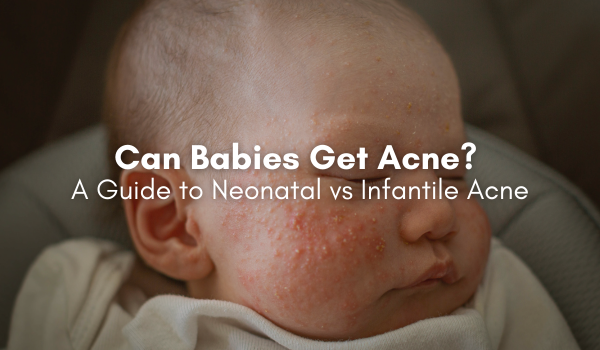
Many parents are surprised to notice tiny red or white bumps appearing on their baby’s skin. Is that acne… on a newborn? While it might sound unusual, acne can indeed affect babies – and it’s more common than you might think. However, not all baby breakouts are the same. Two main types of acne can appear in early life: neonatal acne (commonly called baby acne) and infantile acne.
This guide will help you understand the difference between these conditions, how to tell them apart from other baby skin rashes, and when to see a pediatric dermatologist.
What is Baby Acne?
Neonatal acne, also known as “baby acne,” appears in newborns, typically within the first few weeks of life. Despite its name, it’s very different from the acne experienced by teenagers or adults; true neonatal acne is a harmless and temporary condition, and there is no known correlation between experiencing neonatal acne in infancy and developing normal acne later in life. Baby acne is referred to as such due to its resemblance to mature acne, as it shows up as small red or white bumps on the cheeks, forehead, chin, or sometimes the chest.
What Causes Neonatal (Baby) Acne?
The exact cause of baby acne is not fully known, but many doctors believe it may be related to maternal hormones passed to the baby before birth, skin sensitivity to yeast or bacteria on the skin, or immature oil glands in the skin of the newborn. Baby acne affects approximately 30% of newborns.
Fortunately, neonatal acne usually clears up on its own within a few weeks to a few months. No medical treatment is needed; gentle cleansing with water and avoiding harsh soaps is typically all that is recommended for newborns with acne.
It is important to note that the term “baby acne” is used only to refer to neonatal acne that occurs in newborns. Infantile acne, which appears later in infancy, is a separate condition, not a subtype of baby acne. We’ll now clarify some of the differences between neonatal acne and infantile acne.
Neonatal Acne vs. Infantile Acne
Though these two types of acne may sound synonymous, neonatal acne and infantile acne differ in many ways, including age of onset, appearance, and treatment. The biggest clue as to whether your baby is experiencing neonatal or infantile acne is your child’s age; if the acne appears after 6 weeks of age, it is probably infantile acne, not baby acne.
Age of Onset
- Neonatal acne appears anywhere between birth and 6 weeks.
- Infantile acne typically occurs between 3 and 6 months of age.
Appearance
- Neonatal acne looks like tiny red bumps or whiteheads.
- Infantile acne may include larger red bumps, whiteheads, blackheads, and sometimes cysts.
Cause
- Neonatal acne may be caused by maternal hormones, skin sensitivity, or immature oil glands (although the exact cause is unknown).
- Infantile acne is usually caused by the baby’s own hormones.
Treatment
- Neonatal acne typically requires no treatment and resolves on its own.
- Infantile acne may require topical or oral medication prescribed by a dermatologist.
Duration
- Neonatal acne often resolves within a few weeks, although it can stretch to months.
- Infantile acne may last several months or longer.
While baby acne is almost always temporary and harmless, infantile acne can be more persistent and sometimes requires medical attention. In rare cases, it can leave scars if left untreated, so it’s best to discuss any acne lasting beyond 2-3 months with your pediatric dermatologist.
Also, it is important to consult your dermatologist about how to care for your baby’s acne at home; since babies and newborns have more delicate skin than adults, traditional acne treatment options and even topical creams are often not recommended at such a young age.
How Can I Tell if My Baby Has Acne?
Neonatal or infantile acne isn’t the only cause of small bumps on your infant’s skin. Newborns can develop several harmless skin conditions that look similar, including milia, eczema, and keratosis pilaris (KP). Here are some key ways to tell them apart.
Baby/Infantile Acne vs. Milia
Milia are tiny white bumps often seen on a newborn’s nose, cheeks or chin. Unlike acne, milia are not inflamed or red and don’t have blackheads or pustules. If the bumps on your baby’s skin look like smooth, pearly white dots instead of red bumps, your baby likely has milia, not acne.
Milia is caused by trapped keratin under the skin’s surface. It usually clears up on its own within weeks and does not need treatment.
Baby/Infantile Acne vs. Eczema
Eczema (atopic dermatitis) is an itchy, dry, and often patchy rash that can appear on a baby’s cheeks, scalp, or limbs. If the outbreak looks like red, scaly, or crusty (sometimes oozing) patches and is causing your baby noticeable discomfort, it is probably eczema.
Unlike acne, eczema is not caused by clogged pores or hormones; it is an inflammatory skin condition. Persistent eczema may need evaluation by a dermatologist for appropriate treatment and skin care recommendations.
Baby/Infantile Acne vs. Keratosis Pilaris
Keratosis pilaris (sometimes called “chicken skin”) causes rough, small bumps that can appear on the arms, thighs, cheeks, or even legs. While acne typically does not appear on the limbs, keratosis pilaris often does. If the bumps feel dry and are located on your baby’s arms or legs rather than the fact, it is more likely keratosis pilaris, not acne.
KP is caused by a buildup of keratin blocking hair follicles and typically feels rough or sandpapery, not inflamed like acne. It is a harmless condition, although gentle exfoliation and moisturizer may help; talk to your doctor for the best method to use for your infant with keratosis pilaris.
When to See a Dermatologist for Your Baby’s Acne
Most cases of baby (neonatal) acne clear up without treatment. However, you should schedule a visit with a pediatric dermatologist if:
- The acne lasts beyond 2-3 months
- The bumps look painful, swollen, or oozing
- Your baby develops acne on unusual areas (like the back, chest, or legs)
- The acne develops after 6 weeks of age; your pediatric dermatologist should take a look to evaluate whether it is infantile acne (or something else) and prescribe any needed treatment
Your child’s pediatrician or a pediatric dermatologist can help examine your child’s acne and identify if it is baby or infantile acne, or another pediatric skin condition. Skin breakouts of many kinds are common for infants and babies as they develop and grow accustomed to the world around them.
Looking for pediatric dermatology care in the Pittsburgh area? At Vujevich Dermatology Associates, our board-certified pediatric dermatologist Dr. Elizabeth J. Froelich can help identify the cause of your baby’s skin changes and recommend gentle, safe treatments if needed. Your child’s skin health is our priority, and we’re equipped to help manage infantile acne, atopic dermatitis, and other dermatologic conditions with medically sound, patient-centered care. Call us at 412-429-2570 or visit our contact page to book your appointment in the greater Pittsburgh, PA area. You can also follow us on Facebook and Instagram to see what’s new in the world of dermatology.